
The Human Environment and Transport Inspectorate (ILT) oversees the inland navigation vessels that carry commercial cargo or paying passengers on inland waters in the Netherlands to ensure they follow the laws and regulations set out by the Government of the Netherlands. This contributes to safer inland waterways in the Netherlands.
Collaboration in oversight
The ILT oversees inland navigation undertakings, Recognised Organisations (ROs) and expert agencies, boatmasters and crews, as well as companies involved in the transport of hazardous substances on inland waters in the Netherlands.
To this end, the ILT collaborates with the police, Rijkswaterstaat (executive agency of the Ministry of Infrastructure and Water Management), the port authorities of Amsterdam and Rotterdam, the Nederlandse Arbeidsinspectie, NLA (Netherlands Labour Authority), the Provinces of Fryslân, Groningen and Overijssel, the Municipalities of Aalsmeer and Amsterdam and Waterschap Rivierenland (Rivierenland Region Water Authority).
Inland navigation inspections
The ILT conducts 2 types of inspections on inland navigation vessels operating on inland waters in the Netherlands: company inspections and object inspections.
The ILT primarily focuses on market regulation (equal competitive conditions), rules for crew members (sailing and rest times, manning level and sailing logbooks) and areas where repeated violations of rules and regulations occur.
You are obliged to cooperate with an inspection according to Article 5:20 of the Algemene wet bestuursrecht, AWB (General Administrative Law Act, in Dutch). If you do not cooperate, you may receive a penalty. After you have paid the penalty, you must still cooperate with the inspection.
Bedrijfsinspecties (company inspections) are off-site checks conducted on the administrative records of operators of inland navigation vessels on inland waters in the Netherlands. During these inspections, the ILT assesses whether your company complies with the Binnenvaartwet (Inland Navigation Act) and the Arbeidstijdenwet, ATW (Working Hours Act).
If the ILT has selected you for a company inspection, you will receive a letter detailing how to prepare your documents for inspection. It will specify, amongst others, which documents the ILT inspector needs copies of and from which time period they are required. You must provide the requested documents to the ILT using the Melding aanleveren informatie bedrijfsinspectie binnenvaart form (in Dutch). If you cannot provide the documents in this way, the ILT inspector will visit your company to review the documents with you on site.
You can read more about inland navigation company inspections in the werkinstructie bedrijfsinspectie binnenvaart (inland navigation company inspection instructions, in Dutch).
ILT inspectors may conduct unannounced checks on board inland navigation vessels on inland waters in the Netherlands to ensure that the vessel, crew, certificates and permits comply with the laws and regulations set out by the Government of the Netherlands. These are called objectinspecties (object inspections). You can read more about inland navigation object inspections in the werkinstructie objectinspectie binnenvaart (inland navigation object inspection instructions, in Dutch).
Fines and suspensions for violations of the rules and regulations
The ILT may issue warnings for certain violations of the Inland Navigation Act and the Working Hours Act. In case of serious or repeated violations, the ILT may impose a bestuurlijke boete (administrative fine, in Dutch), if you, for example, fail to provide certain information. You may request a betalingsregeling (payment scheme, in Dutch) if you cannot pay the fine straight away.
- The fines for violations of the Inland Navigation Act are specified in the Binnenvaartregeling (Inland Navigation Regulation, in Dutch).
- The fines for violations of the Working Hours Decree for Transport are detailed in a policy rule (in Dutch).
If an inland navigation vessel does not meet the requirements, lacks valid mandatory certificates, provisional certificates, or other documents, or if safe navigation cannot be guaranteed for any other reason, the ILT may detain the vessel. The owner must ensure that the vessel complies with all rules and regulations before it is allowed to continue sailing.
Inland shipping risk model
Despite the close collaboration, there are not enough people and resources to inspect every vessel on inland waterways in the Netherlands. For this reason, the ILT uses the inland shipping risk model, which helps the ILT inspector to make well-informed choices.

In the Netherlands, the ILT, the Port of Amsterdam, the Port of Rotterdam, Rijkswaterstaat and the National Police of the Netherlands oversee the inland shipping sector. The focus is on safety, the environment and fair market conditions, as violations of rules and regulations can provide an unfair competitive advantage. Despite the close collaboration, there are not enough people and resources to inspect all vessels. A risk model helps to make informed choices. Before an inspection, the model predicts how likely an operator is to violate a rule or regulation. These predictions help inspectors focus on vessels with a higher risk and avoid inspecting those that are more likely to follow the rules.
The inland shipping risk model consists of rules for calculating the likelihood of a violation. This is also known as an algorithm. To develop the model, a form of artificial intelligence (AI) called machine learning was used. The computer learns from many past examples to identify which characteristics of a vessel or company are relevant in predicting a violation. The calculation rules are therefore based on statistics rather than on an inspector’s estimation. The model applies to all inland vessels, even those that have not been inspected before.
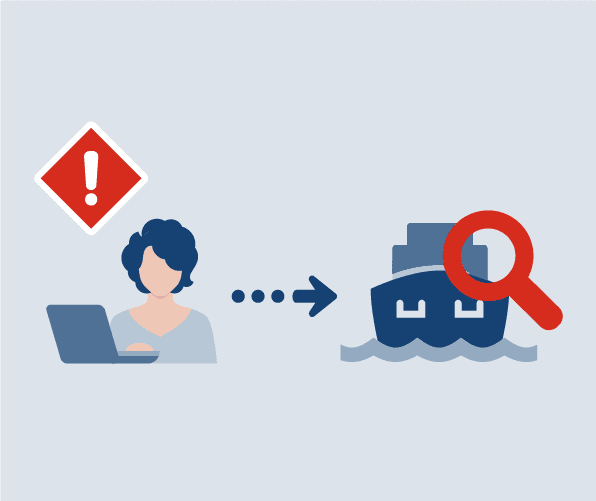
When several vessels are moored or passing by, the inspector compares the likelihood of violations between them. The risk score serves as an advisory tool. Ultimately, it is always the inspector who decides whether or not to board a vessel. The inspector also considers past inspections and assesses the vessel’s condition. If the inspector inspected a vessel recently, they will not inspect it again solely based on a high risk score. This procedure is laid down in the inspector’s werkinstructie objectinspectie binnenvaart (inland navigation object inspection instructions, in Dutch).
You will not notice any difference. Your vessel will not be inspected more often than usual, in line with the inspector’s werkinstructie objectinspectie binnenvaart (inland navigation object inspection instructions, in Dutch). The inspection will be carried out in accordance with the law. It makes no difference why a vessel was selected for inspection. Violations and any resulting measures are always based on the inspector’s findings, not on the risk prediction.
No, the risk model is not always right. If very little is known about a vessel, the risk model is more likely to make an incorrect prediction. More centralised information about all vessels, owners and operators will become available in the future. Moreover, when major changes occur in the sector, such as new legislation, it may take some time before the model adapts to the new situation. The model is then updated as quickly as possible.
Yes, the risk model is fair. It has been trained on data from different vessel types and ownership categories. It makes roughly the same number of errors for independent operators as for large owners or operators and it makes no difference which supervisory authority carried out a vessel’s previous inspections. Moreover, no personal data have been included and the risk model has been assessed for full compliance with all applicable laws and regulations.
A vessel inspection with few or no violations results in a lower, improved risk score. Information about inspections, permits and ownership is updated daily, and these updates are immediately reflected in the predictions. The risk model takes into account information from the past 5 years.